
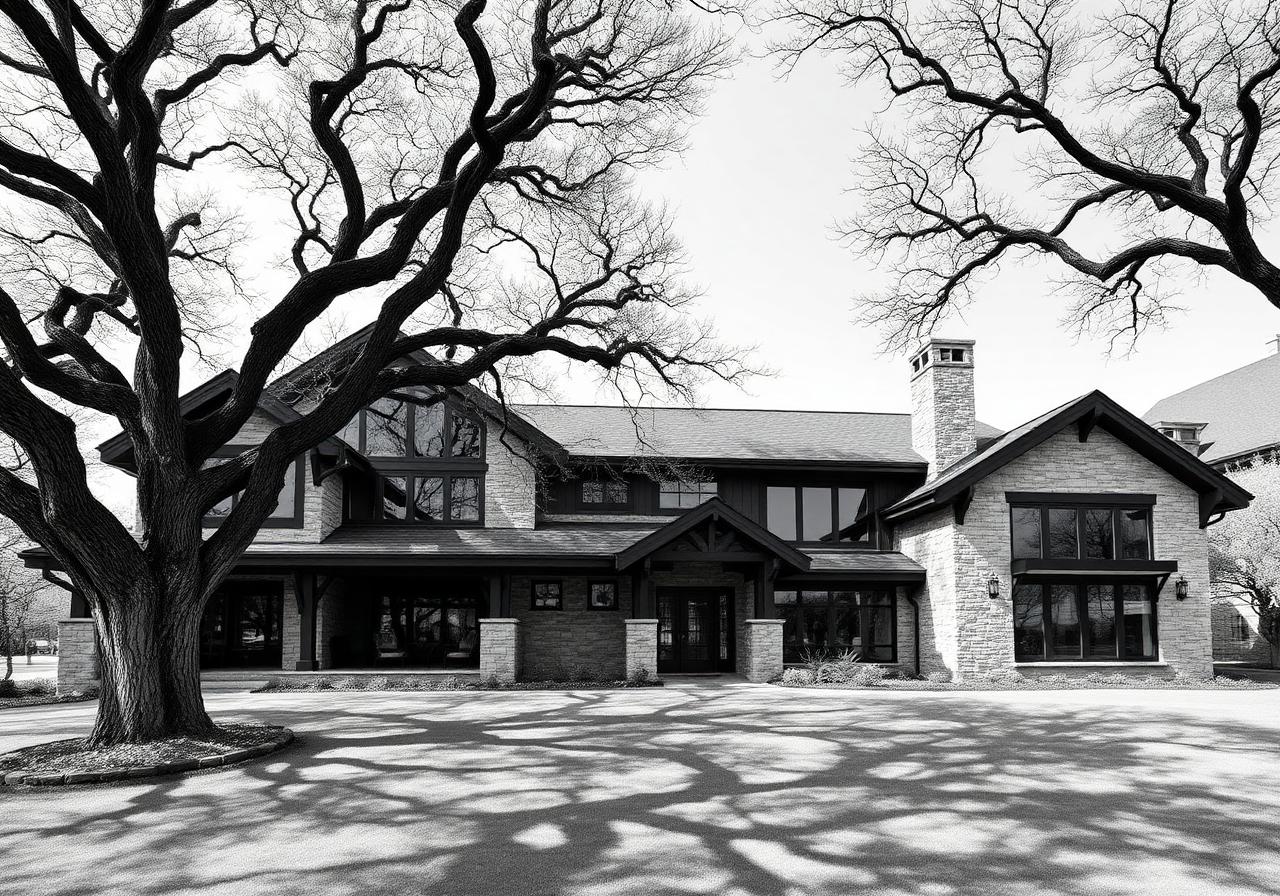
Why Travis Country's age matters
You will not find new construction in Travis Country. The oldest homes were built starting in 1975. The newest additions were completed in the late 1990s. Every home here is at least 26 years old, and many are approaching 50. This is not a flaw. Established neighborhoods trade novelty for something more reliable: foundation movement that has settled, mature landscaping, and neighbors who have lived here for decades.
The three phases of development
Trailwood Village arrived first in 1975, with 438 homes averaging 4 bedrooms, 2 bathrooms, and 2,053 square feet. These are the original homes, on the western side of the neighborhood, among the most mature landscaping and closest to the greenbelt. Most have undergone some renovation.
Village Park at Travis Country (1996, 526 homes) is larger on average — 4 bedrooms, 3 bathrooms, 2,414 square feet. Mature enough to have settled but new enough to still have systems with useful life remaining.
Travis Country Green (1998, 130 homes) is the newest cluster, averaging 4 bedrooms, 3 bathrooms, and 2,875 square feet. The newest systems and the homes that have had the least time to settle.
Before you write an offer, ask your agent which phase a home is in. That single fact tells you a lot about what to expect on inspection.
Greenbelt backing: the premium and the trade-offs
Many Travis Country homes, especially in Trailwood Village, have greenbelt access or backing. Privacy, permanent open space, and proximity to 7.2 miles of trails. But these properties may sit within or adjacent to floodplain areas. Before you submit an offer, ask the listing agent explicitly whether the property has any FEMA floodplain designation. Get clarity in writing.
Greenbelt backing also means limited privacy in one direction and potential for seasonal runoff. Ask the current owner directly about any history of water intrusion or drainage problems during the last five years.
The housing stock: original and updated homes
Most homes in Travis Country fall into one of two categories. Original 1970s and 1980s homes need careful evaluation. Austin sits on expansive clay soil that shrinks and swells dramatically with moisture, and many older homes show measurable foundation movement by age 40 or 50.
1970s homes also frequently have original HVAC systems, cast iron drain lines that may be corroded, and roofing long since expired. Windows in original homes are often single-pane aluminum. 1970s homes built in certain areas may also have aluminum wiring instead of copper, a known fire hazard at connection points.
The HOA and amenity membership
Travis Country has a Community Service Association (CSA) that manages two recreation centers (Blue Valley and Hilltop), eight tennis courts, basketball, picnic areas, and 1.5 miles of nature trail. Membership comes with a fee. Do not rely on third-party estimates. Contact the TCCA directly at tcmanager@traviscountry.com or 512-289-1616. Board meetings are the third Thursday of each month at 6 PM (no December meeting), open to the public, often via Zoom.
School zoning and attendance
AISD assigns schools based on attendance boundaries that shift periodically. Travis Country straddles a boundary area, and your specific address determines your school assignment. Use the AISD School Finder on austinisd.org and confirm with the district during your due diligence period. Verify again before closing.
Commute reality check
MoPac is the primary corridor for Travis Country residents heading north or downtown, and it is chronically congested. Test drive your actual route during the exact time you would commute, on a weekday, during peak hours. Leave at 8:00 AM on a Thursday and again on a Monday. The worst assumption is "I will leave early" or "traffic will improve." Confirm the commute works for you before you buy.
Inspection priorities for this housing stock
A professional home inspection is non-negotiable. Some items deserve special attention here.
- Foundation movement is the first priority. Have your inspector elevation-test the slab.
- Roof condition. Have a roofer climb the roof, not just your general inspector. Ask how many years of useful life remain.
- Main sewer line camera inspection on any home built 1970s through early 1990s. $300 to $500, and tells you exactly what you are inheriting.
- HVAC inspection by a licensed AC contractor on pre-2000 systems.
- Electrical evaluation by a licensed electrician if aluminum wiring is suspected.
Renovation potential
Most homes in Travis Country have renovation potential because lots are generous and the greenbelt provides privacy and permanence. Prioritize what delivers value at resale: kitchens, bathrooms, roofing, HVAC, and plumbing. Lot improvements like landscaping, deck building, and fence replacement are also valuable, especially for greenbelt homes where the view and privacy are part of the draw.
Working with an agent who knows Travis Country
This neighborhood has history, character, and repeat patterns that matter. An agent who has sold multiple homes here, who understands the three phases, and who knows the school zoning puzzle and the CSA structure is worth more than a generic Austin realtor. Ask directly: "How many homes have you sold in Travis Country in the last 12 months?"
Your closing checklist: questions for the listing agent
Get these answers in writing as a condition of your offer:
- Has the home ever had foundation repairs or movement issues? Request documentation.
- What is the age of the roof, HVAC, and main water heater? When were they last serviced or replaced?
- For Trailwood Village or other original-section homes, does it have aluminum wiring? Documentation, please.
- What is the CSA amenity membership status? Any history of special assessments or planned improvements affecting dues?
- Is the property currently in or adjacent to a FEMA floodplain? Request the maps.
- Exact school attendance boundaries for the current zoning year?
- What buyer-paid inspections have been done? Reports, please.
